BNF 以及 EBNF
通常情况下,你很少会在入门书籍里读到关于 Backus-Naur Form(BNF,巴科斯-诺尔范式)和 Extended Backus-Naur Form(EBNF)的话题 —— 它们都被普遍认为是 “非专业人士无需了解的话题”,隐含的另外一层含义是 “反正就算给他们讲他们也无论如何看不懂”……
然而,在我眼里,这事非讲不可 —— 这是这本 “书” 的设计目标决定的。
严格意义上来讲,在《自学是门手艺》中,以自学编程为例,我完全没必要自己动手耗时费力写那么多东西 —— 如果仅仅是为了让读者 “入门” 的话。编程入门书籍,或者 Python 编程入门书籍,都已经太多太多了,其中质量过硬的书籍也多得去了 —— 并且,如果你没有英文阅读障碍,那你就会发现网上有太多非常优质的免费教程…… 真的轮不到李笑来同学再写一次。
我写这本书的目标是:
让读者从认知自学能力开始,通过自学编程作为第一个实践,逐步完整掌握自学能力,进而在随后漫长的人生中,需要什么就去学什么,
…… 不用非得找人教、找人带 —— 只有这样,前途这两个字才会变得实在。
于是,我最希望能做到的是,从这里了解了自学方法论,也了解了编程以及 Python 编程的基础概念之后,《自学是门手艺》的读者能够自顾自地踏上征程,一路走下去 —— 至于走到哪里,能走到哪里,不是我一个作者一厢情愿能够决定的,是吧?
当然,会自学的人运气一定不会差。
于是,这本 “书” 的核心目标之一,换个说法就是:
我希望读者在读完《自学是门手艺》之后,有能力独立地去全面研读官方文档 —— 甚至是各种编程语言、各种软件的相关的文档(包括它们的官方文档)。
自学编程,很像独自一人冲入了一个丛林,里面什么动物都有…… 而且那个丛林很大很大,虽然丛林里有的地方很美,可若是没有地图和指南针,你就会迷失方向。
其实吧,地图也不是没有 —— 别说 Python 了,无论什么编程语言(包括无论什么软件)都有很翔实的官方文档…… 可是吧,绝大多数人无论买多少书、上多少课,就是不去用官方 “地图”,就不!
—— 其实倒不是说 “第三方地图” 更好,实际的原因很不好意思说出来:
- 这首先吧,觉得官方文档阅读量太大了……(嗯?那地图不是越详细越好吗?)
- 那还有吧…… 也不是没去看过,看不懂……(嗯…… 这对初学者倒是个问题!)
所以,我要认为这本 “书” 的最重要工作是:
为读者解读清楚地图上的 “图例”,从此之后读者在任何需要的时候能够彻底读懂地图。
在阅读官方文档的时候,很多人在 The Python Tutorial 上就已经觉得吃力了…… 如果到了 Standard Libraries 和 Language References 的部分,就基本上完全放弃了,比如,以下这段摘自 string —— Common string operations:
Format Specification Mini-Language ... The general form of a standard format specifier is:
format_spec     ::=  [[fill]align][sign][#][0][width][grouping_option][.precision][type]
fill            ::=  <any character>
align           ::=  "<" | ">" | "=" | "^"
sign            ::=  "+" | "-" | " "
width           ::=  digit+
grouping_option ::=  "_" | ","
precision       ::=  digit+
type            ::=  "b" | "c" | "d" | "e" | "E" | "f" | "F" | "g" | "G" |
                     "n" | "o" | "s" | "x" | "X" | "%"
...
读到这,看着一大堆的 ::= [] | 当场傻眼了……
这是 BNF 描述,还是 Python 自己定制的 EBNF…… 为了理解它们,以后当然最好有空研究一下 “上下文无关文法”(Context-free Grammar),没准未来你一高兴就会去玩一般人不敢玩的各种 Parser,甚至干脆自己写门编程语言啥的…… 不过,完全可以跳过那些复杂的东西的 —— 因为你当前的目标只不过是 “能够读懂那些符号的含义”。
其实吧,真的不难的 —— 它就是语法描述的方法。
比如,什么是符合语法的整数(Integer)呢?符合以下语法描述的是整数(使用 Python 的 EBNF):
integer ::= [sign] digit +
sign    ::= "+" | "-"
digit ::= "0" | "1" | "2" | "3" | "4" | "5" | "6" | "7" | "8" | "9"以上的描述中,基本符号没几个,它们各自的含义是:
::=表示定义;< >尖括号里的内容表示必选内容;[ ]中是可选项;" "双引号里的内容表示字符;|竖线两边的是可选内容,相当于or;*表示零个或者多个……+表示一个或者多个……
于是:
interger定义是:由 “可选的sign” 和 “一个或者多个digit的集合” 构成 —— 第一行末尾那个+的作用和正则表达式里的+一样;sign的定义是什么呢?要么是+要么是-;digit的定义是什么呢?从"0"到"9"中的任何一个值……
于是,99、+99、-99,都是符合以上语法描述的 integer;但 99+ 和 99- 肯定不符合以上语法描述的 integer。
很简单吧?反正就是在 ::= 左边逐行列出一个语法构成的所有要素,而后在右边逐行逐一定义,直至全部要素定义完毕。
也许那些在此之前已经熟悉 BNF 范式的人会有点惊讶,“你怎么连 ‘终结符’ 和 ‘非终结符’ 这种最基本的概念都跳过了?” —— 是呀,即便不讲那俩概念也能把这事讲清楚到 “能马上开始用” 了的地步…… 这就是我经常说的,“人类有这个神奇的本领,擅长使用自己并不懂的东西……”
Python 对 BNF 的拓展,借鉴了正则表达式[1] —— 从最后两个符号的使用(* +)你可以看得出来。顺带说,这也是为什么这本 “书” 里非要讲其他入门书籍里不讲的正则表达式的原因之一。
又由于 Python 的社区文档是二十来年长期积累的,有时标注方法并不一致。比如,在描述 Python Full Grammar specification 的时候,他们用的语法标注符号体系就跟上面描述 String 的语法不一样了,是这样的:
:表示定义;[ ]中是可选项;' '引号里的内容表示字符;|竖线两边的是可选内容,相当于or;*表示零个或者多个……+表示一个或者多个……
—— 用冒号 : 替代了 ::=,用单引号 '' 替代了双引号 "",而尖括号 <> 干脆不用了:
# Grammar for Python

# NOTE WELL: You should also follow all the steps listed at
# https://devguide.python.org/grammar/

# Start symbols for the grammar:
#       single_input is a single interactive statement;
#       file_input is a module or sequence of commands read from an input file;
#       eval_input is the input for the eval() functions.
# NB: compound_stmt in single_input is followed by extra NEWLINE!
single_input: NEWLINE | simple_stmt | compound_stmt NEWLINE
file_input: (NEWLINE | stmt)* ENDMARKER
eval_input: testlist NEWLINE* ENDMARKER

decorator: '@' dotted_name [ '(' [arglist] ')' ] NEWLINE
decorators: decorator+
decorated: decorators (classdef | funcdef | async_funcdef)

async_funcdef: 'async' funcdef
funcdef: 'def' NAME parameters ['->' test] ':' suite

parameters: '(' [typedargslist] ')'
typedargslist: (tfpdef ['=' test] (',' tfpdef ['=' test])* [',' [
        '*' [tfpdef] (',' tfpdef ['=' test])* [',' ['**' tfpdef [',']]]
      | '**' tfpdef [',']]]
  | '*' [tfpdef] (',' tfpdef ['=' test])* [',' ['**' tfpdef [',']]]
  | '**' tfpdef [','])
tfpdef: NAME [':' test]
varargslist: (vfpdef ['=' test] (',' vfpdef ['=' test])* [',' [
        '*' [vfpdef] (',' vfpdef ['=' test])* [',' ['**' vfpdef [',']]]
      | '**' vfpdef [',']]]
  | '*' [vfpdef] (',' vfpdef ['=' test])* [',' ['**' vfpdef [',']]]
  | '**' vfpdef [',']
)
vfpdef: NAME

stmt: simple_stmt | compound_stmt
simple_stmt: small_stmt (';' small_stmt)* [';'] NEWLINE
small_stmt: (expr_stmt | del_stmt | pass_stmt | flow_stmt |
             import_stmt | global_stmt | nonlocal_stmt | assert_stmt)
expr_stmt: testlist_star_expr (annassign | augassign (yield_expr|testlist) |
                     ('=' (yield_expr|testlist_star_expr))*)
annassign: ':' test ['=' test]
testlist_star_expr: (test|star_expr) (',' (test|star_expr))* [',']
augassign: ('+=' | '-=' | '*=' | '@=' | '/=' | '%=' | '&=' | '|=' | '^=' |
            '<<=' | '>>=' | '**=' | '//=')
# For normal and annotated assignments, additional restrictions enforced by the interpreter
del_stmt: 'del' exprlist
pass_stmt: 'pass'
flow_stmt: break_stmt | continue_stmt | return_stmt | raise_stmt | yield_stmt
break_stmt: 'break'
continue_stmt: 'continue'
return_stmt: 'return' [testlist]
yield_stmt: yield_expr
raise_stmt: 'raise' [test ['from' test]]
import_stmt: import_name | import_from
import_name: 'import' dotted_as_names
# note below: the ('.' | '...') is necessary because '...' is tokenized as ELLIPSIS
import_from: ('from' (('.' | '...')* dotted_name | ('.' | '...')+)
              'import' ('*' | '(' import_as_names ')' | import_as_names))
import_as_name: NAME ['as' NAME]
dotted_as_name: dotted_name ['as' NAME]
import_as_names: import_as_name (',' import_as_name)* [',']
dotted_as_names: dotted_as_name (',' dotted_as_name)*
dotted_name: NAME ('.' NAME)*
global_stmt: 'global' NAME (',' NAME)*
nonlocal_stmt: 'nonlocal' NAME (',' NAME)*
assert_stmt: 'assert' test [',' test]

compound_stmt: if_stmt | while_stmt | for_stmt | try_stmt | with_stmt | funcdef | classdef | decorated | async_stmt
async_stmt: 'async' (funcdef | with_stmt | for_stmt)
if_stmt: 'if' test ':' suite ('elif' test ':' suite)* ['else' ':' suite]
while_stmt: 'while' test ':' suite ['else' ':' suite]
for_stmt: 'for' exprlist 'in' testlist ':' suite ['else' ':' suite]
try_stmt: ('try' ':' suite
           ((except_clause ':' suite)+
            ['else' ':' suite]
            ['finally' ':' suite] |
           'finally' ':' suite))
with_stmt: 'with' with_item (',' with_item)*  ':' suite
with_item: test ['as' expr]
# NB compile.c makes sure that the default except clause is last
except_clause: 'except' [test ['as' NAME]]
suite: simple_stmt | NEWLINE INDENT stmt+ DEDENT

test: or_test ['if' or_test 'else' test] | lambdef
test_nocond: or_test | lambdef_nocond
lambdef: 'lambda' [varargslist] ':' test
lambdef_nocond: 'lambda' [varargslist] ':' test_nocond
or_test: and_test ('or' and_test)*
and_test: not_test ('and' not_test)*
not_test: 'not' not_test | comparison
comparison: expr (comp_op expr)*
# <> isn't actually a valid comparison operator in Python. It's here for the
# sake of a __future__ import described in PEP 401 (which really works :-)
comp_op: '<'|'>'|'=='|'>='|'<='|'<>'|'!='|'in'|'not' 'in'|'is'|'is' 'not'
star_expr: '*' expr
expr: xor_expr ('|' xor_expr)*
xor_expr: and_expr ('^' and_expr)*
and_expr: shift_expr ('&' shift_expr)*
shift_expr: arith_expr (('<<'|'>>') arith_expr)*
arith_expr: term (('+'|'-') term)*
term: factor (('*'|'@'|'/'|'%'|'//') factor)*
factor: ('+'|'-'|'~') factor | power
power: atom_expr ['**' factor]
atom_expr: ['await'] atom trailer*
atom: ('(' [yield_expr|testlist_comp] ')' |
       '[' [testlist_comp] ']' |
       '{' [dictorsetmaker] '}' |
       NAME | NUMBER | STRING+ | '...' | 'None' | 'True' | 'False')
testlist_comp: (test|star_expr) ( comp_for | (',' (test|star_expr))* [','] )
trailer: '(' [arglist] ')' | '[' subscriptlist ']' | '.' NAME
subscriptlist: subscript (',' subscript)* [',']
subscript: test | [test] ':' [test] [sliceop]
sliceop: ':' [test]
exprlist: (expr|star_expr) (',' (expr|star_expr))* [',']
testlist: test (',' test)* [',']
dictorsetmaker: ( ((test ':' test | '**' expr)
                   (comp_for | (',' (test ':' test | '**' expr))* [','])) |
                  ((test | star_expr)
                   (comp_for | (',' (test | star_expr))* [','])) )

classdef: 'class' NAME ['(' [arglist] ')'] ':' suite

arglist: argument (',' argument)*  [',']

# The reason that keywords are test nodes instead of NAME is that using NAME
# results in an ambiguity. ast.c makes sure it's a NAME.
# "test '=' test" is really "keyword '=' test", but we have no such token.
# These need to be in a single rule to avoid grammar that is ambiguous
# to our LL(1) parser. Even though 'test' includes '*expr' in star_expr,
# we explicitly match '*' here, too, to give it proper precedence.
# Illegal combinations and orderings are blocked in ast.c:
# multiple (test comp_for) arguments are blocked; keyword unpackings
# that precede iterable unpackings are blocked; etc.
argument: ( test [comp_for] |
            test '=' test |
            '**' test |
            '*' test )

comp_iter: comp_for | comp_if
sync_comp_for: 'for' exprlist 'in' or_test [comp_iter]
comp_for: ['async'] sync_comp_for
comp_if: 'if' test_nocond [comp_iter]

# not used in grammar, but may appear in "node" passed from Parser to Compiler
encoding_decl: NAME

yield_expr: 'yield' [yield_arg]
yield_arg: 'from' test | testlist
现在你已经能读懂 BNF 了,那么,可以再读读用 BNF 描述的 Regex 语法[2],就当复习了 —— 很短的:
BNF grammar for Perl-style regular expressions

<RE>             ::=  <union> | <simple-RE>
<union>          ::=  <RE> "|" <simple-RE>
<simple-RE>      ::=  <concatenation> | <basic-RE>
<concatenation>  ::=  <simple-RE> <basic-RE>
<basic-RE>       ::=  <star> | <plus> | <elementary-RE>
<star>           ::=  <elementary-RE> "*"
<plus>           ::=  <elementary-RE> "+"
<elementary-RE>  ::=  <group> | <any> | <eos> | <char> | <set>
<group>          ::=  "(" <RE> ")"
<any>            ::=  "."
<eos>            ::=  "$"
<char>           ::=  any non metacharacter | "\" metacharacter
<set>            ::=  <positive-set> | <negative-set>
<positive-set>   ::=  "[" <set-items> "]"
<negative-set>   ::=  "[^" <set-items> "]"
<set-items>      ::=  <set-item> | <set-item> <set-items>
<set-item>       ::=  <range> | <char>
<range> ::= <char> "-" <char>真的没原来以为得那么神秘,是不?[3]
都学到这儿了…… 顺带再自学个东西吧。
这个东西叫 glob,是 Global 的缩写。你可以把它理解为 “超级简化版正则表达式” —— 它最初是 Unix/Posix 操作系统中用来匹配文件名的 “通配符”。
先看一张 1971 的 Unix 操作系统中关于 glob 的截图:
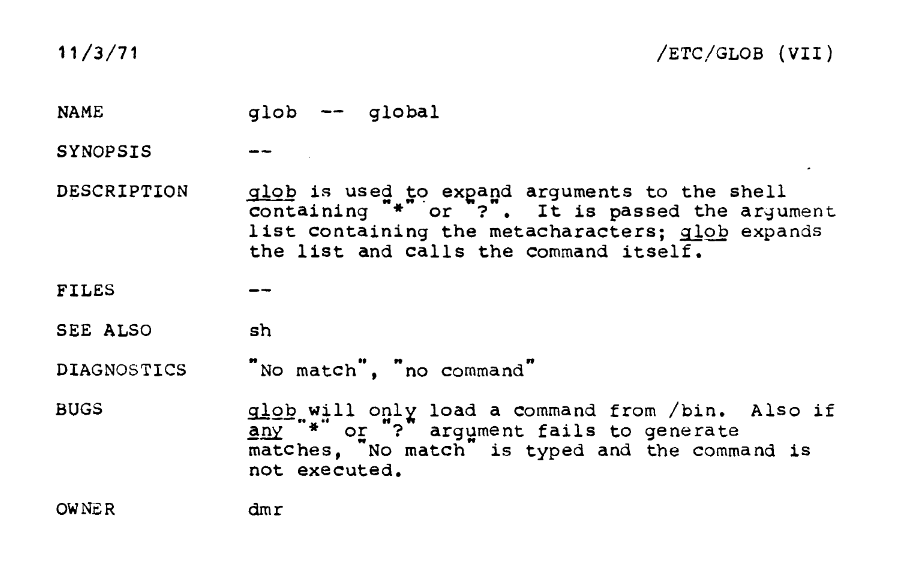
A screenshot of the original 1971 Unix reference page for glob – note the owner is dmr, short for Dennis Ritchie.
glob 的主要符号只有这么几个:
*?[abc][^abc]
现在的你,打开 Wikipedia 上的关于 glob 和 Wildcard character 的页面,肯定能做到 “无障碍” 理解:
顺带说,现在你再去读关于 Format String 的官方文档,就不会再觉得 “根本看不懂” 了,恰恰相反,你会觉得 “我怎么之前连这个都看不懂呢?”
https://docs.python.org/3/library/string.html#format-string-syntax
在自学这件事上,失败者的死法看起来千变万化,但其实都是一样的…… 只不过是因为怕麻烦或者基础知识不够而不去读最重要的文档。
比如,学英语的时候死活不读语法书。其实英文语法书也没多难啊?再厚,不也是用来 “查” 的吗?不就是多记几个标记就可以读懂的吗?比如,词性标记,v., n., adj., adv., prep.... 不就是相当于地图上的图例吗?那语法书,和现在这里提到的官方文档,不都是 “自学者地图” 吗?
但就是这么一点点简单的东西,挡住了几乎所有人,真是可怕。
脚注
[1]:The Python Language Reference » 1.2 Notation —— 这个链接必须去看一看……
[2]:Perl Style Regular Expressions in Prolog CMPT 384 Lecture Notes Robert D. Cameron November 29 - December 1, 1999
[3]:很少有人注意到:在很多编程语言的文法文档中,"$" 被称为 <eos> —— 2017 年 5 月我投资了一个初创公司,听说他们的资产名称叫做 eos…… 我当场就被这个梗逗乐了。